
Blog
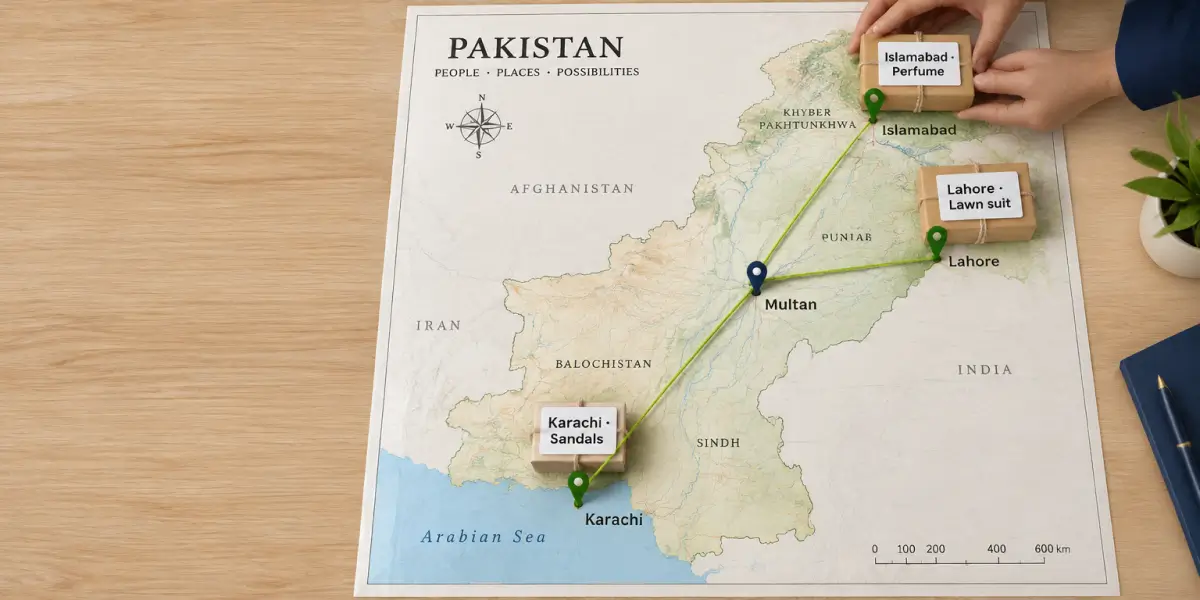
A customer in Multan adds a lawn suit, a pair of sandals and perfume to one cart. The suit is in your Lahore warehouse, the sandals are with a vendor in Karachi, and the perfume is in a store in Islamabad. One checkout, three locations. That is where order splitting starts.
This guide explains what order splitting is, when it happens, how a multi vendor order moves from checkout to cash, and how Pakistani sellers can run it without errors.
What is order splitting in ecommerce?
Order splitting is the process of breaking one order into smaller sub-orders, each fulfilled from a different source. Every sub-order gets its own:
- Fulfilment location or vendor
- Packing and dispatch
- Courier booking and tracking number
- Delivery status
- COD amount (if the customer pays on delivery)
The customer places one order and gets one order number. Behind the scenes, your system manages several shipments.
Why do ecommerce orders get split?
Orders are split for five common reasons:
- Multi vendor marketplace: Items in the cart belong to different sellers.
- Multiple warehouses or stores: No single location has every item in stock.
- Stock shortage: Part of the order is ready now, the rest is coming later.
- Product type: Fragile, bulky or high-value items need separate handling.
- Pre-orders: One item ships today, a pre-order item ships on launch.
For Pakistani fashion, beauty and lifestyle brands that sell through a website, marketplaces and physical stores, the second reason is the most common.
How are multi vendor orders processed? Step by step
Here is how a multi vendor order moves through the system, from checkout to cash.
1. Order is captured
The customer places the order on your website, app, marketplace or social store. The order lands in one central system, not in separate inboxes.
2. Stock is checked across all locations
The system checks which vendor, warehouse or store has each item available right now.
3. The order is split into sub-orders
Items are grouped by location. Rules decide the split, for example: ship from the location closest to the customer, keep items together where possible, or prefer the location with the most stock.
4. Each vendor or location is notified
Every fulfilment point sees only its part of the order and gets an alert to pick and pack.
5. A courier is booked for each shipment
Each sub-order gets its own airway bill. The courier can differ by location, based on who performs best on that route.
6. The customer gets tracking for every parcel
The customer should know up front: your order will arrive in 3 parcels. Each parcel has its own tracking update by SMS or email.
7. COD is collected per parcel
If the order is COD, each rider collects only the amount for the parcel being delivered.
8. Payments and returns are reconciled per sub-order
Collected cash, courier charges and returns are matched against each sub-order, then rolled up to the parent order and to each vendor.
Example: one order, three shipments
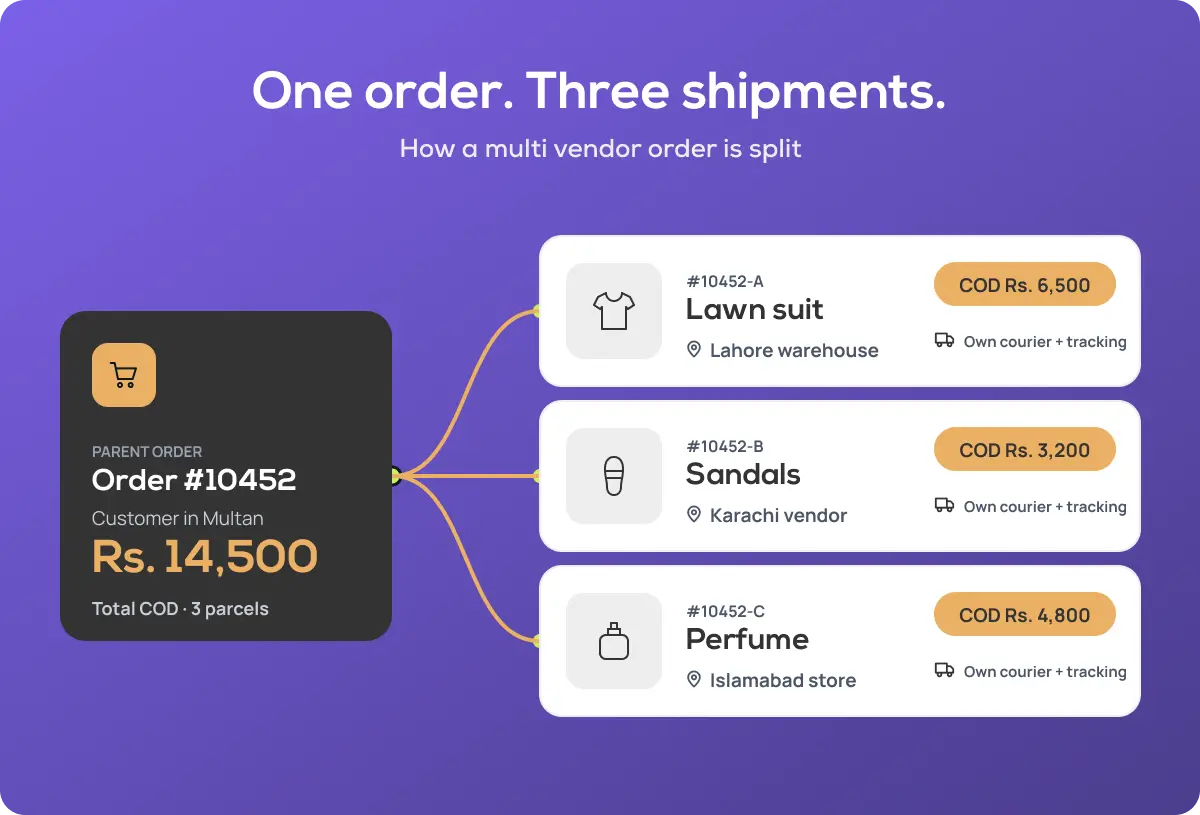
Order splitting and COD: the Pakistan challenge
In a COD-heavy market, splitting adds risk that sellers in prepaid markets do not face:
- Partial refusals: The customer accepts the first parcel but refuses the second.
- Confusion at the door: The customer expects to pay Rs 14,500 once, but the rider asks for Rs 3,200.
- Higher delivery cost: Three parcels mean three shipping charges, and three chances of a return.
- Slow reconciliation: Cash comes back from different couriers on different days.
How to reduce the risk:
- Show the number of parcels and the amount per parcel at checkout and in the confirmation SMS.
- Confirm high-value split orders by call or WhatsApp before dispatch.
- Encourage prepaid or partial upfront payment on split orders to cut refusals.
- Track COD and returns at the sub-order level, not only the order level.
Split shipment vs single shipment: which is better?
Rule of thumb: split when it gets the customer their items meaningfully faster or avoids a stock-out. Consolidate when the delay is short and the cart value is low.
Problems with manual order splitting
Many Pakistani sellers still split orders by hand. The usual result:
- Orders copied between spreadsheets and WhatsApp groups
- Items promised from a store that has already sold out
- Couriers booked twice, or not at all
- COD amounts that do not match what was delivered
- Customers calling support because they received half an order
At 50 orders a day this is manageable. At 500 or 5,000, it breaks.
How XStak OMS handles multi location and multi vendor orders
XStak Order Management System is a cloud-based, distributed order and inventory management system built for brands that sell across online and offline channels. For order splitting, it brings the steps above into one place:
- One order view across every channel: Website, marketplace and in-store orders are managed in a single system.
- Real-time inventory across locations: Stock syncs between your web store, warehouses and physical stores, with POS and ERP integrations, so orders are assigned only where stock exists.
- Automated order assignment: Orders are routed to the right fulfilment location instead of being assigned by hand.
- Location alerts: Store managers receive SMS and email alerts when an order is assigned to their location.
- Multi courier booking: Each shipment can be booked with the courier that performs best for that location, local or global.
- Real-time tracking and customer alerts: Customers get SMS and email updates on order status.
- Ship from store and click and collect: Supports buy online deliver to home, buy online pick up in-store, and ship from store.
- Role-based access and REST APIs: Business managers, store managers and support teams each see what they need, and the API connects your other systems.
Real results: Bonanza Satrangi was manually assigning more than 5,000 daily orders to the nearest location with available stock. With XStak OMS automating that process, the brand processes 5,000+ orders a day and reported a 50% increase in daily revenue (case study).
XStak OMS runs on a transaction-based pricing model, with no heavy setup or yearly licence fees.
Marketplace example: Zarr. Zarr, Jazz's digital fashion and lifestyle marketplace, brings many local and international brands into one storefront. So a single Zarr cart often holds items from two or three brands, each shipping from its own warehouse or store. With XStak OMS, each Zarr order is split by brand automatically:
- Each brand sees and fulfils only its own sub-order
- Each parcel is booked with a courier and tracked separately
- The customer still shops, pays and tracks under one order number
- Payments and returns are reconciled per brand, not by hand
The result is a true multi vendor marketplace experience for the shopper, without manual sorting of orders between brands.
XStak OMS runs on a transaction-based pricing model, with no heavy setup or yearly licence fees.
Best practices for order splitting in Pakistan
- Set clear split rules: Decide when to split and when to wait, based on distance, stock and cart value.
- Keep stock accurate in real time: Most split-order failures start with wrong inventory.
- Tell the customer early: Show parcel count and per-parcel COD at checkout.
- Choose couriers by route: Book each parcel with the courier that performs best on that lane.
- Push prepaid on split orders: Online or partial upfront payment reduces refusals and speeds up cash.
- Reconcile per sub-order: Match cash, delivery charges and returns for every parcel and every vendor.
- Measure it: Track split rate, delivery success per parcel, partial refusal rate and cost per order.
Frequently asked questions
What is order splitting in ecommerce?
Order splitting is when one customer order is divided into two or more shipments because the items come from different vendors, warehouses or stores. Each shipment is packed, booked and tracked separately under one parent order.
What is a sub-order?
A sub-order is one part of a split order. It contains the items shipped from a single location or vendor and has its own tracking number and payment amount.
How does COD work on a split order in Pakistan?
Each parcel carries its own COD amount. The rider collects only the value of the parcel being delivered, and the seller reconciles each parcel separately.
Does order splitting increase shipping cost?
Yes, usually. More parcels mean more courier charges. Sellers balance this against faster delivery and fewer cancellations from out-of-stock items.
How do marketplaces handle multi vendor orders?
The marketplace splits the order by seller, sends each seller their items, books a courier per shipment and settles payment with each seller separately.
Which software handles order splitting for Pakistani brands?
An order management system (OMS) such as XStak OMS centralises orders from every channel, checks stock across locations, assigns orders automatically and books couriers per shipment.
Run split orders without the chaos
If your team is splitting orders by hand across stores, warehouses or vendors, an OMS turns it into one automated flow, from checkout to delivery to cash.
Book a demo of XStak OMS and see how your orders can be routed, booked and tracked from one dashboard.
Related Posts

Become An Omnichannel Retailer
Take a personalized tour of XStak's retail operating modules with our Sales experts and learn how XStak can enable you to grow.
